A Moving-Day Plan for Giving Useful Objects Their Next Job
A moving-day plan for useful objects helps you choose what to keep, offer, donate, or recycle before packing, with clear actions for each item.
At the back of a kitchen drawer, a spare whisk, a chipped mug, and a sturdy lunch tin wait beside the packing tape. A moving-day plan for useful objects gives each one a destination before it goes into a box. That keeps uncertainty from turning into automatic packing or a last-minute discard pile.
Start by asking what each object could do after the move, then check whether that use is realistic. A mixing bowl may belong in the next kitchen. A spare desk lamp may suit a relative setting up a study. A clean coat may be welcome at a local clothing program, but only if the program accepts it.
Choose a destination
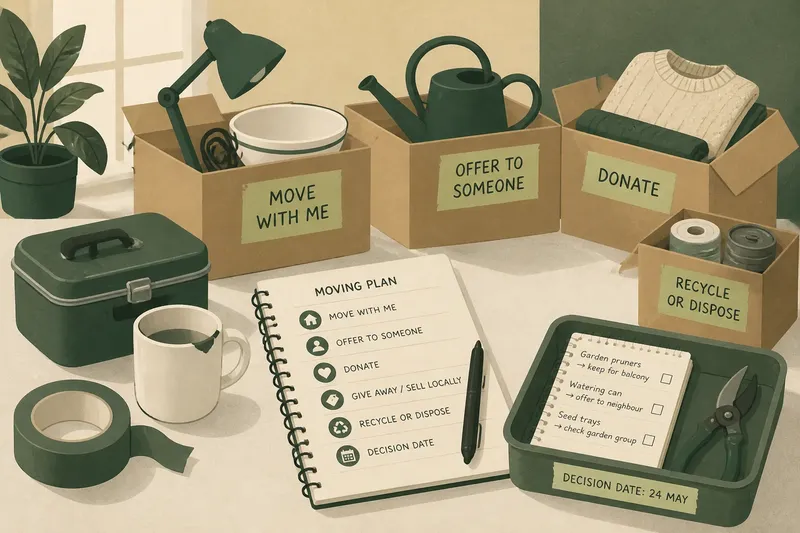
Use a short list of routes that fits your move. Each route should lead to a real person, place, or action:
- Move with me: If you can name a likely use and a place for the item, pack it for the new home; if not, consider another route.
- Offer to someone: If a named person has a plausible use, ask whether they want it; if they decline or do not respond by your chosen date, move to another suitable option.
- Donate: If a local organization confirms it accepts the item in its current condition, arrange drop-off; if it does not, check another recipient or route.
- Give away or sell locally: If you have time to coordinate collection, post a clear description; if pickup does not work before the move, choose another practical route.
- Recycle or dispose: If the item is no longer usable, check local handling rules; if the route is unclear or specialized, ask the relevant local service.
- Decide by a set date: If an item still needs thought, put it in one small, marked holding area and set a decision date; if it remains unresolved then, choose from the routes available rather than packing it by default.
These are practical options, not moral grades. Keeping something is sensible when it has a likely use and a place. Passing it on is sensible when someone can accept it and the handoff can happen in time.
Sort by likely use
Work through one area at a time, such as the entryway or linen closet. Pick up each object and ask what it does, whether it works as intended, and where that function will be needed. Seeing an object in its usual setting can make its role clearer than trying to remember it from a general list.
For tools, consider both the task and the condition. A screwdriver set that suits routine household work may earn space in the new home. A duplicate could go to a neighbor who has asked for one. A tool with a damaged handle should not be offered as ready to use simply because it once served you well.
For household goods, consider fit as well as condition. A large roasting pan may be sound but awkward in a smaller kitchen. If you will not use it, identify a recipient with a clear use or a donation site that accepts cookware.
Say you are moving from a house with a garden to an apartment with a small balcony. You have hand pruners, a watering can, and seed trays. You decide to take the pruners because you plan to care for balcony plants, offer the watering can to a gardening neighbor, and check whether a local garden group accepts the clean trays. The resulting plan gives each object a separate route instead of putting all three into an unmarked “garden” box.
Make routes workable
An intended destination helps only when you can complete the handoff. For a direct offer, send a short message that names the item and its condition. Add a photo when it would clarify size or wear. Give the person a reply date that leaves time for another option, and do not pack an item for someone who has not agreed to take it.
Before donating, check the organization’s current acceptance guidance. A place may accept some household goods but not others, and its drop-off process may have changed. If an item is declined, take it back and choose another route; do not leave it at the door.
Local giveaway groups and resale listings can work for larger items, but they require coordination. State whether the recipient must collect the item, agree on a pickup window, and remove the listing when the item is no longer available. If a handoff becomes impractical as moving day approaches, change the plan instead of letting the item travel with you without a reason.
Recycling is different from donation. Materials and collection rules vary by location, and a mixed-material object may need special handling. Follow local guidance. For items with safety, legal, or specialized disposal concerns, contact the relevant local service or a qualified professional.
Track each decision
Mark the route where you can see it. Painter’s tape on a box or a note in your phone can say “new home,” “offer to Sam,” or “donation drop-off.” For bulky objects, attach a note where it will not be missed. Keep destination labels separate from room or fragile labels so packing directions do not cause confusion.
For unresolved items, record three things: the object, the person or place to contact, and the date for a decision. If someone else is helping with the move, name who will make the call or carry out the drop-off. Keep this holding group in one small tray, corner, or box, and revisit it before packing is nearly done.
Moving-day plan questions?
Should I keep a spare?
Keep it if you can name a likely use, such as a backup bulb of the right type or extra sheets for expected guests. If it duplicates something you rarely use or has no place in the new home, offer it or find another suitable destination.
What if it might be useful someday?
Name the task and the place where the item would be used. If you cannot do that, “someday” is not yet a workable destination, so consider an offer or donation while there is time to arrange it.
Can I pass on a damaged object?
Describe the damage and whether the object remains safe and functional. If it is broken or unsafe, do not present it as ready to use; if repair is part of the plan, state who will handle it rather than implying the recipient should take on the work.
What if nobody accepts it?
Try another suitable person or organization while time remains. If the object is no longer usable, follow the local disposal route; a refusal is a sign that the proposed handoff does not fit, not a reason to leave it unplanned.
Prepare the handoff
Keep related parts together. Put a lamp’s removable shade with its base, place small hardware in a labeled bag, and include instructions or care notes when they will help the next owner. Leave out loose pieces with no clear connection to the object.
Clean items enough to make their condition clear and their next use practical. Dry them before boxing, and protect fragile goods during transport. If something needs repair before use, say so plainly; tidy wrapping should not hide a problem.
Before a person-to-person handoff, confirm that the recipient still wants the item and agree on a time and place. For an organization, follow its drop-off process. A short note of what has left and what remains can help prevent duplicate offers or accidental packing.
A moving-day plan for useful objects is working when you can state each item’s next job and the action that will get it there. If the route depends on an uncertain handoff, choose a practical alternative while there is still time; if the item has a clear use and place in the new home, pack it deliberately.