Why a Mortise-and-Tenon Joint Holds Together
Learn why a mortise-and-tenon joint resists movement through fitted bearing surfaces, how shoulders and grain direction contribute, and where glue fits.
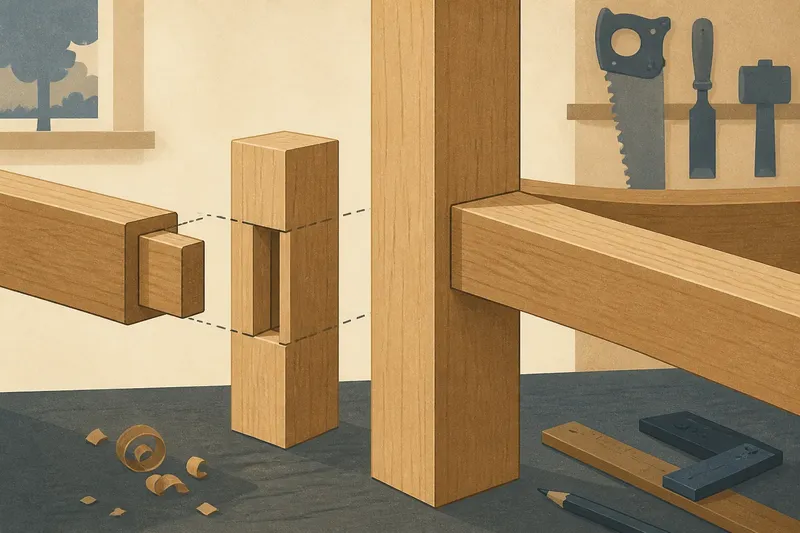
A chair leg rocks slightly when you press on the seat, so you turn the chair over and find a rail meeting the leg at a square wooden joint. A mortise-and-tenon joint connects those pieces by fitting a projecting tongue, the tenon, into a matching opening, the mortise. Its strength comes from the shape and contact of the wood, not from glue alone.
What is a mortise-and-tenon joint?
A mortise-and-tenon joint is a woodworking connection in which one piece has a projecting end that enters a cavity in another piece. The projection is the tenon; the cavity is the mortise. A rail joined to a table leg is a familiar example: the tenon extends from the rail and sits inside the mortise cut into the leg.
The two parts are shaped to meet closely. The tenon’s broad faces sit against the mortise’s inner walls, while its shoulders—the wider edges around its base—meet the surface of the receiving piece. These are bearing surfaces: areas where wood physically presses against wood when the joint is loaded.
That contact distinguishes the joint from a connection held only by adhesive. A correctly fitted tenon has wood around it that limits movement in more than one direction. Glue may reinforce the connection, but the geometry already gives the pieces a way to bear against each other.
How does the joint resist movement?
The tenon’s broad faces bear against the mortise walls. If a rail is pushed sideways, one face presses on a wall rather than sliding freely through the opening. The close fit also limits twisting, because rotation brings different parts of the tenon into contact with the walls.
The shoulders provide another kind of restraint. When the tenon is seated, the shoulders touch the outside face of the mortised piece. They help prevent the rail from moving farther into the opening and make the connection look settled rather than gapped. Under some loads, a shoulder also spreads pressure over a broader area than the tenon’s end alone could.
Think of the joint as a collection of surfaces with distinct jobs. The tenon’s sides resist sideways movement and rotation. Its end meets the bottom of a closed mortise, if the opening does not pass all the way through. The shoulders register the joint at the surface and resist inward movement. The exact contribution of each surface depends on the joint’s shape and the direction of force.
Fit matters because contact matters. If the tenon is so loose that it barely touches the walls, the pieces can shift before the surfaces begin to bear against each other. If it is forced into an opening that is too tight, the wood may split or the joint may not seat fully. A sound fit brings the faces into contact without requiring damaging force.
What do the shoulders do?
Shoulders are the parts of the rail that remain outside the mortise when the tenon is inserted. They form a boundary around the projection and meet the face of the leg or other receiving piece. A full shoulder can surround the tenon; some joints use shoulders on only selected sides.
Because a shoulder rests against the receiving surface, it helps control how deep the tenon enters. It can also help keep the rail square to the leg. When the shoulder closes evenly around the joint, it offers a visual cue that the tenon is seated and that the adjoining faces meet.
A small gap at a shoulder does not automatically reveal the cause. The tenon may be too long, the mortise may be too shallow, or the shoulder itself may not be square to the rail. For a maker, that visible gap is useful feedback: it identifies a mismatch at the meeting surfaces. For someone caring for an old object, it is a reason to inspect the joint rather than force the parts together.
Does it need glue?
A mortise-and-tenon joint can resist movement through its fit and bearing surfaces, but that does not mean glue is never useful. Adhesive can help keep the tenon seated and distribute stress across contacting surfaces. In a well-made joint, it supplements the wood-to-wood connection rather than replacing it.
Glue cannot make a badly mismatched joint fit well. If the tenon is undersized, the adhesive may fill some of the gap, but the pieces still lack close bearing contact. If the joint is over-tight, adding glue does not remove the risk of splitting or incomplete seating. The joint’s geometry remains central.
Some designs also use a wedge, pin, or other mechanical feature to secure the tenon. Those details change how the joint is assembled and how it resists withdrawal. A through tenon, for instance, passes through the receiving piece and may be visible on the far side; a blind tenon stops inside it. Each form has different demands, so the appropriate method depends on the object’s design and condition.
Which kinds are common?
The basic joint has many variations, but they share the same principle: a shaped projection enters a matching opening and bears against it.
- Blind mortise and tenon: The mortise stops inside the receiving piece, hiding the tenon’s end. The joint is useful where a clean outside face matters.
- Through mortise and tenon: The mortise passes through the receiving piece, so the tenon can emerge at the far side. That visible end can be left plain or secured by a suitable design detail.
- Haunched tenon: A small extension, or haunch, fills part of the mortise opening near an edge. It can help keep a frame member aligned while leaving the main tenon to provide the core connection.
- Wedged tenon: A slit in the projecting end accepts a wedge that spreads the tenon within the mortise. The wedge changes the fit and requires a design that can accommodate that expansion.
These names describe construction choices, not a ranking of strength. A joint’s performance depends on its proportions, the wood, the grain direction, the quality of the fit, and the forces the object must handle.
What affects the fit?
Wood is not a uniform, directionless material. Its grain runs along the length of a board, and the structure behaves differently along and across that grain. A tenon cut with attention to grain direction can keep useful continuous fibers in the projecting piece. A mortise placed too close to an edge may leave little wood to contain the opening, making that area more vulnerable to splitting.
The width and thickness of the tenon also affect how it bears. A very thin tenon offers less surface at its sides. A mortise that removes too much material from a narrow leg can weaken the surrounding wood. Makers balance the size of the projection against the amount of sound wood that must remain around it.
Moisture changes can affect the fit because wood expands and contracts as its moisture content changes. The movement is not identical in every direction. A joint designed with that movement in mind is less likely to become either loose or excessively constrained as conditions shift.
Imagine a maker fitting a rail into a chair leg and finding that the shoulders meet on one side but leave a narrow gap on the other. The maker checks whether the tenon is centered and whether the shoulder is square, then adjusts the mismatch before assembly. The expected visible result is an even meeting line, with the tenon’s faces seated against the mortise walls rather than rocking in a loose opening.
How can you read a loose joint?
A loose mortise-and-tenon joint may show a moving rail, a visible shoulder gap, or a small change in alignment when the object is gently handled. Those signs indicate that contact between parts has changed, but they do not identify the cause by themselves. Wear, a poor original fit, damage, or movement in the surrounding wood can all contribute.
Start with observation rather than force. Look for cracks beside the mortise, missing wood at the tenon, old adhesive residue, or a joint that shifts in one direction more than another. Note whether the movement comes from the joint itself or from another connection nearby. Avoid rocking a fragile object repeatedly to “check” it, since that can add stress to already weakened fibers.
For a valuable, antique, or load-bearing piece, a furniture conservator or experienced repair professional can assess the joint and choose an appropriate repair. The right approach may depend on the wood, prior repairs, and how the object is used. Simply adding glue to the visible gap can trap debris, interfere with a later repair, or fail to address the loose bearing surfaces.
Why do the details matter?
A mortise-and-tenon joint holds together because its parts are shaped to meet under pressure. The tenon’s sides bear on the mortise walls, and the shoulders help locate and support the connection. Fit, grain, and the amount of surrounding wood determine how well those surfaces can do their work.
That is why the joint is more than a peg hidden inside a hole. Its geometry gives the pieces a physical relationship that can resist sliding and twisting, while glue or other retainers may add support. When considering a mortise-and-tenon joint, look at how the surfaces meet and how the wood around them remains intact; those details explain more than the joint’s name alone.